Bobcaygeon’s South School
In the 1840s, schooling in the new colonial settlements was typically voluntary, conducted in either homes or churches. John Taylor, a carpenter (his projects included the Langton’s home Blythe) was instrumental in setting up the first school in the township in a log cabin on the largest of Bobcaygeon’s islands, which was operational by 1846. For its time and place it was unusual to have a purpose-built school. Taylor personally taught the school and his family was also instrumental in setting up the Methodist Church, Mechanics Institute (which is now called the Public Library) and the Red School (S.S.#9 Verulam) which was immediately south of Bobcaygeon. By the 1860s, there was still a log schoolhouse on the island, and also one in a lean-to attached to a tavern in Rokeby (as the north shore of Bobcaygeon was known). At the time it was important to have a school within convenient walking distance for all children.
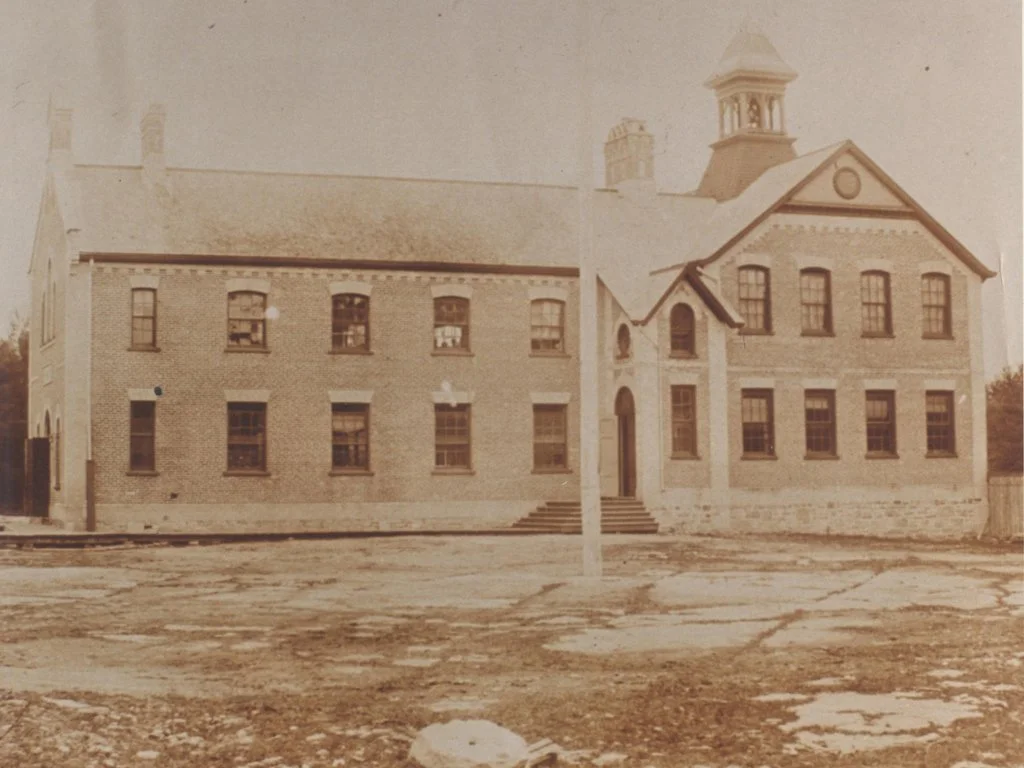
In 1873, new brick buildings superseded both schools serving students living around the rapids between Sturgeon and Pigeon Lakes. The Rokeby School was a one storey building (budgeted at $1,200), while the Bobcaygeon school had two large classrooms (budget $2,400), one on each floor. W. Cosh constructed both schools, at a total cost of $5,190. In that era, village schools often contained very large classes by present-day standards, where multiple grades were taught together. To have two classrooms so that students could be divided by grade was better than most students could expect in that era.
In 1889, Messrs. Cosh and Lancaster built an addition costing $2,560 on the back of the school, augmenting it to a total of four classrooms. That year, it received a 250 pound school bell. Two years later, fire drills were introduced, a new requirement of the Department of Education. In the early twentieth century, continuation classes (later called secondary schooling) were sometimes taught at the south school, when a qualified teacher was available and enough students enrolled—particularly from 1920 to 1929. After 1929, continuation courses were taught at the Hillcroft School which was located on the Fenelon Road, at the village’s northwest corner. That year, Rokeby’s public school closed, as its students were transferred to the south school. Miss Bonnell bought the Rokeby building in 1937 for $600. That year, Isla Herbert introduced formal music classes at Bobcaygeon’s public school.
Hillcroft closed in June 1953 as the Victoria County School Board consolidated its students into Fenelon Falls High School (later Fenelon Falls Secondary School)—made possible with the advent of school busing. The old “Hillcroft High” could then be used to alleviate overcrowding at Bobcaygeon Public School (as the south school was then known). In 1956, a new Bobcaygeon Public School opened on Balaclava Street, which included six classrooms. In 1969, the surrounding one-room schools closed, as Bobcaygeon’s building was vastly expanded to accommodate all of Verulam Township’s elementary students. In 1978, a new public school opened in Dunsford to educate students from south Verulam.
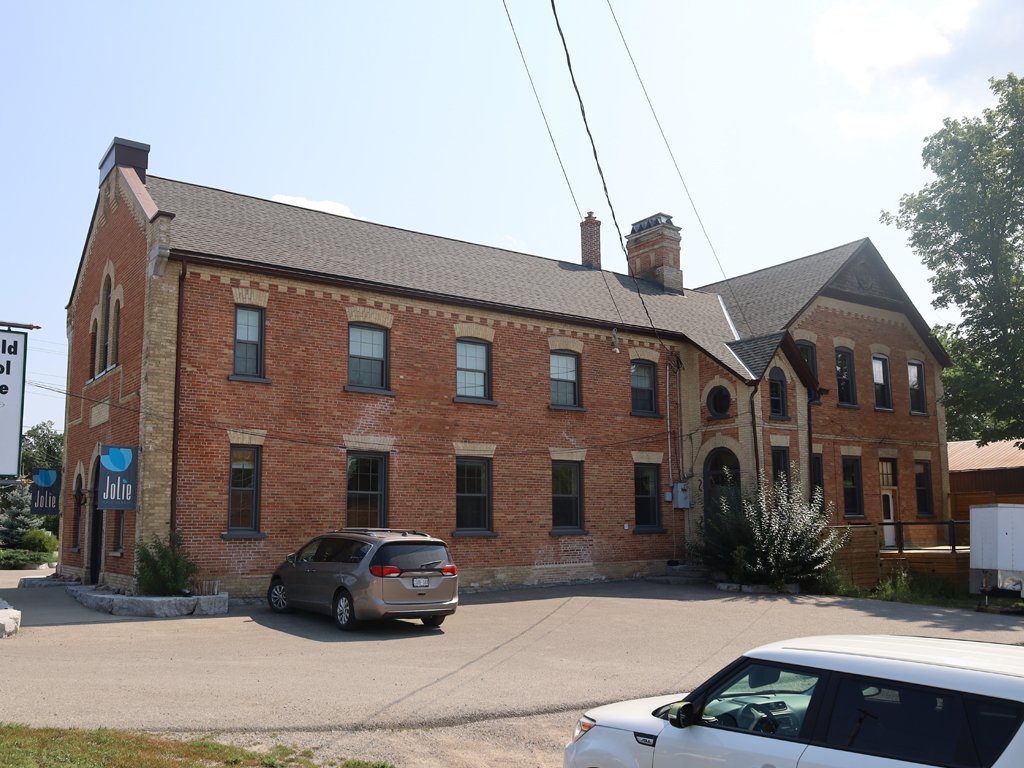
After the south school closed, K. Reid purchased the building. Since then, it has been repurposed many times—Cornerstone Furniture, Dr. Fagan’s Office, Pat Warren’s Radiology Clinic, a Buy and Sell and an Art Gallery to name a few. More recently it has been the home of Jolie Hair Studio, Kelli Lovell Real Estate and Muster Point. But for all the changes over the years, the building is still recognizable as the old schoolhouse, though the belfry and the front chimney have disappeared