Fenelon Falls’ Swing Railway Bridge
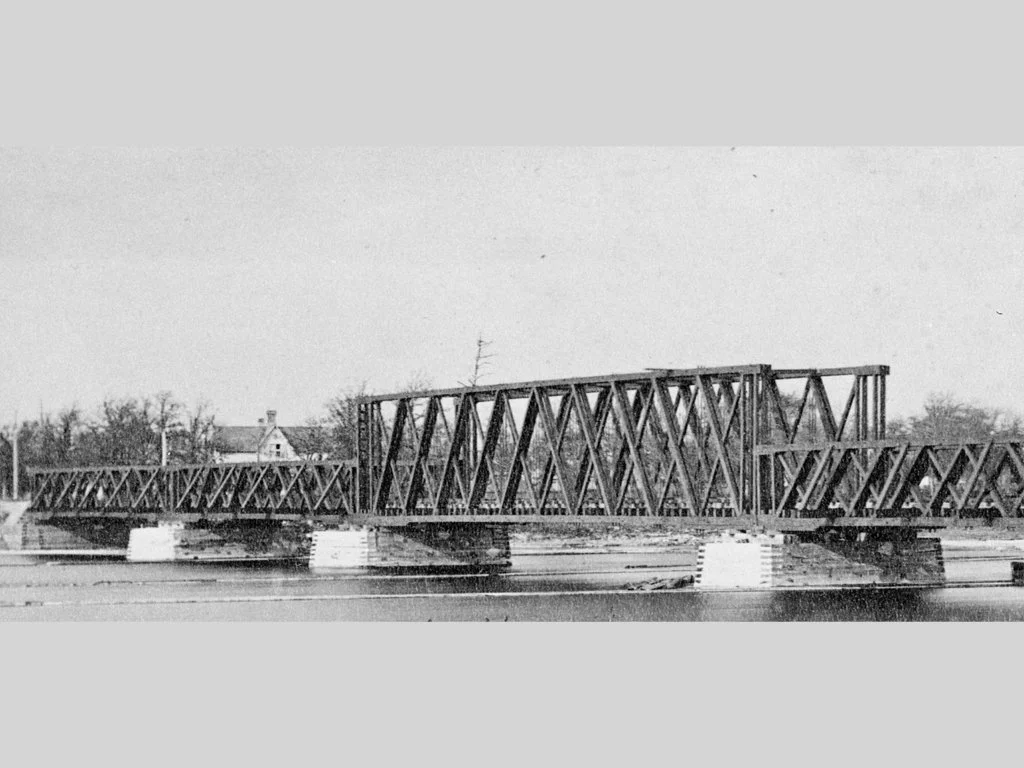
When the Victoria Railway was constructed in the mid-1870s, Fenelon Falls was still a waterfall with a cascade located above it. A mill dam had been constructed across the river to direct water to saw and grist mills beside the falls that had commenced work in the 1830s, but there was no boat traffic on the river. Before the railway was constructed, much of the traffic to and from Fenelon Falls came by water. There was a lower wharf located just below the falls on the north shore, and another wharf on Cameron Lake. In the 1880s, there was a foundry and pulp mill on the shore of the lake, around where Garnet Graham Park is located today. So, as the railway was first built, it was a fixed bridge spanning the river at the mouth of Cameron Lake.
After a generation of political advocacy to construct the Trent Waterway, work began on the Fenelon Falls locks in 1882. With the technology of the day, raising boats around Fenelon Falls was challenging and required a flight of two locks. But for all the money that was spent excavating the canal and building the locks, and all the ink that had been spilled to persuade the government to undertake this project, boats still could not pass from Sturgeon to Cameron Lake because there was a fixed railway bridge in the way, which was just over a decade old.
For six years, the Canadian Government and the Grand Trunk Railway litigated over who would have to pay for the new bridge. The case centred on whether or not the bridge blocked a navigable waterway at the time it was constructed, if it did the railway would be responsible, if it did not the government would have to pay. The government contended that prior to the lock’s construction, the Fenelon River was navigable right up to the precipice of the falls, while the railway countered that this was nonsense—and won in the end.
While the litigation was ongoing the steamer Anglo-Saxon had been waiting to begin service passing through the lock, but by the time it was functional the boat had rotted. It was pulled out into Cameron Lake and scuttled. A.W. Parkin’s Water Witch, became the first boat to pass through the locks on May 12, 1894, and countless more followed in the years to come. The structure served as a railway bridge until 1981, when a group of recreational travellers made the last trip up the Victoria Railway. Soon after the tracks were taken up. In the mid 1990s, the railway became a multi-use recreational trail, and today the bridge swings twice a year—opening in spring to facilitate boat traffic, and closing in the fall for the use of the recreational corridor. For generations, local youth have made a sport of jumping off the train bridge.