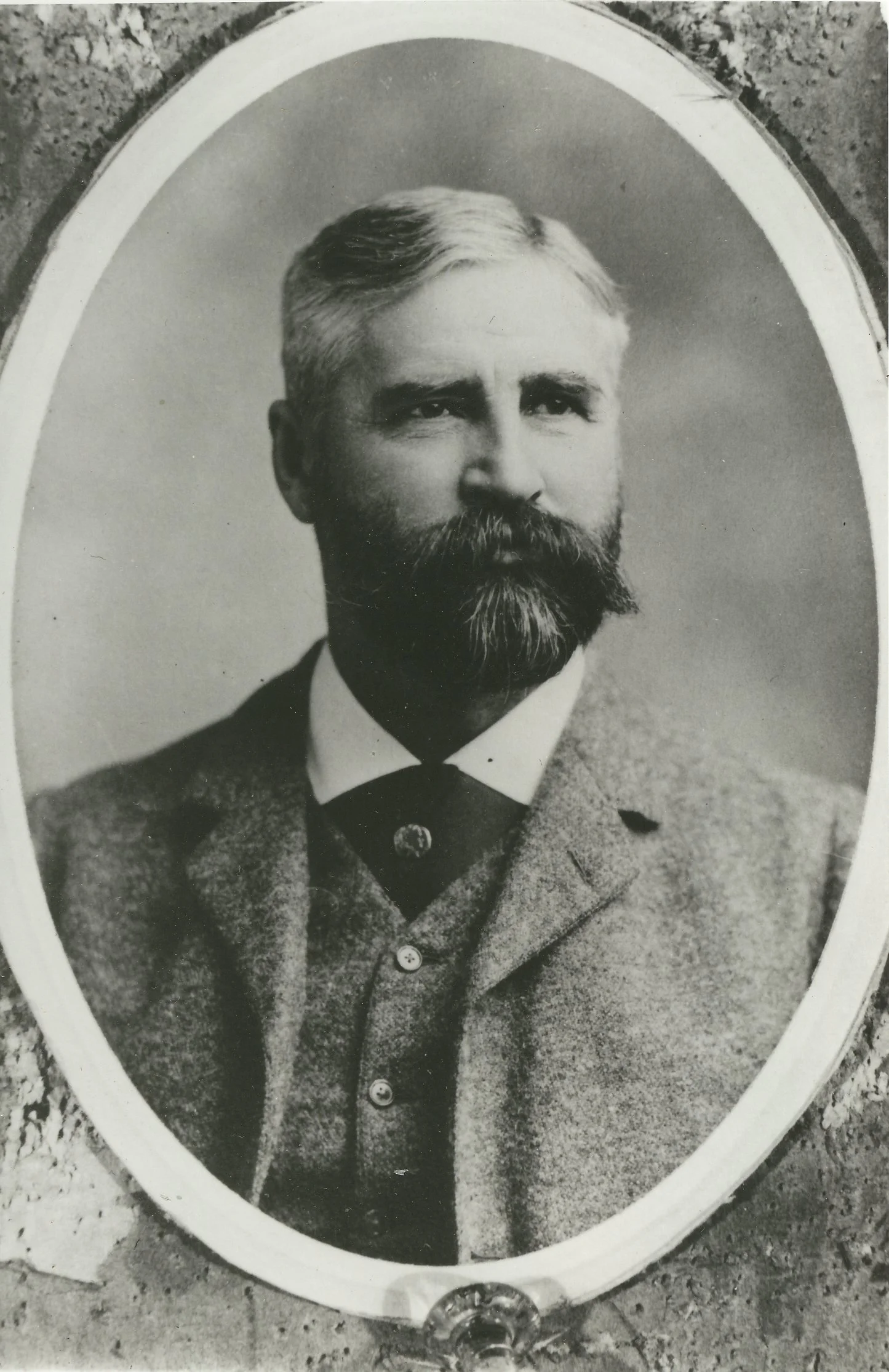
Mossom Martin “Mossie” Boyd was the fifth of Mossom Boyd’s children. His father came to Bobcaygeon as an orphan and worked his way up to become “the Lumber King of the Trent.” Mossie was born in 1855 and grew up as his father’s business became one of the most successful lumber companies in Canada. By the time his father passed away in 1883, Mossie’s brother Gardiner and brothers-in-law James Irwin and John MacDonald helped to market the produce in the United States through associated companies. But the supplies of timber tributary to the Bobcaygeon mill were finite.
After the death of two men heavily involved in marketing the lumber (Christie Johnson, 1891 and John MacDonald, 1892), Mossie and his brother Willie had to raise the money to pay off MacDonald’s share of the company’s capital. They decided to scale back operations at Bobcaygeon. Later they founded the Cowichan Lumber Company in British Columbia.
While Mossie’s father had run the rivers with the rafts of timber, Mossie had more time to pursue his interests. In 1883, he partnered with Willie and John to found the Trent Valley Navigation Company, which operated an integrated steamship transportation network. In that era, most people were farmers, literally living off the fruits of their own labour, produced with little machinery. Finding ways to improve agricultural practice was seen as a great social good, and Mossie was interested in improving beef cattle.
Mossom acquired Big Island (AKA Boyd or Chiminis Island), and Mossie transformed it into one of the most renowned farms in Canada. Initially, he had little experience with breeding fine cattle, so he wrote to Professor William Brown of the Ontario School of Agriculture at Guelph, who suggested he work with some of the most renowned breeders. After briefly breeding Shorthorns (which were then much appreciated for their ability to produce both beef and milk), he moved on to Angus cattle, along with Clydesdale and Percheron horses. The cost of his farming ventures was staggering—thirty of his finest cows might be worth more than the sawmill that had made his father into a millionaire. He sold off much of his herd at Chicago in 1888.
In 1893, while travelling in California, he encountered a buffalo (bison) bull named Napoleon Bonaparte, and believed that crossing Napoleon with domestic cattle would yield “radical improvement obtained in one cross; as much as, or more than, we could reasonably hope to effect in a century by the customary method of selecting.” Napoleon, or Old Boney, as he was familiarly known, arrived in Bobcaygeon in 1894 and became a marvel. The buffalo and descendants were kept on Big Island, but could swim quite well. Mossie’s barn south of Bobcaygeon included a cupola, so his workers could track the animals. Unfortunately, the crossbreeding program did not prove successful, though after Napoleon passed away in 1896, his stuffed head hung in the Bobcaygeon Council chamber. Boyd then moved on to breeding the horns off Hereford Cattle, by intensively breeding freak polled animals. The Polled Hereford became one of the most popular cattle breeds in Canada. For his efforts, Mossie was elected to the Canadian Agricultural Hall of Fame in 1965.