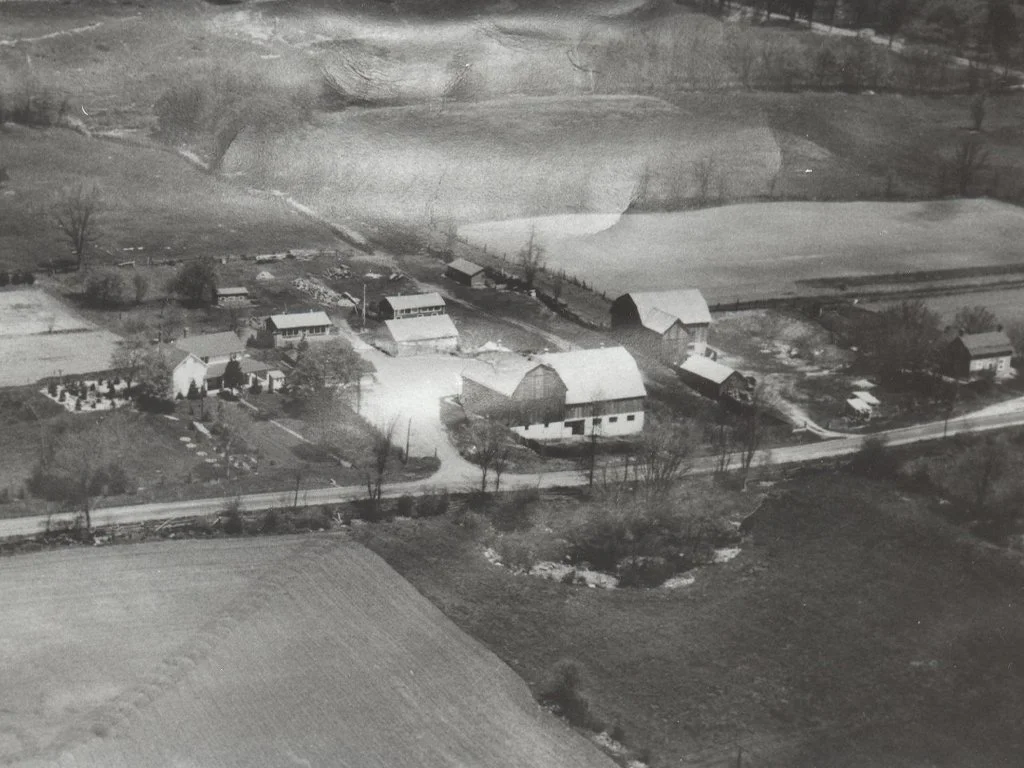
In 1873, Mary Ann (Fitzgerald) Murphy inherited $800 from her father, Gerald Fitzgerald of Lakefield, on the condition that it had to be invested in real estate for the benefit of her and her heirs. It was unusual for the era that property was left specifically to a daughter and her children, without mentioning the husband. She purchased Block U, part of Lot 17, Concession 10 of Verulam, located just north of Rokeby (in those days, Rokeby was the settlement on the north shore, and Bobcaygeon was located on the island, today both are referred to as ‘Bobcaygeon’) from Joseph Gooley, a Bobcaygeon lumber merchant. It was the beginning of three generations of the Murphy family living on this lot. In 1899, her second son, Gerald, acquired the interest of his mother and siblings, agreeing to pay his mother $25 annually, unless she boarded with him for the entire year. After Gerald passed away in 1938, the property passed to his sons Charles Roy and John Clayton Murphy.
The Murphy family built a beautiful, large home that included hardwood floors, a drive shed and a barn, which was built into the side of a hill, as was customary to allow wagons to roll into both the stable and drive floor. Being located on the outskirts of the village, by the 1930s, Gerald specialized in dairy farming, in an era when most farms were mixed farms. Clayton looked after the cattle, while his brother Roy drove around town with a horse and wagon peddling the milk. When someone wanted to buy milk, he would ladle it from steel cans into their containers.
At the time, there were two other dairies in Bobcaygeon, operated by the Crowe (Kawartha Dairy) and Coulter families. There was also a creamery (George and Suzie Lee), plus several cheese factories in the area. There was no legal requirement to pasteurize milk and only Kawartha Dairy had the equipment for this process. An outbreak of tuberculosis among Bobcaygeon children was linked to the Murphy herd, prompting the infected animals to be killed. Rather than investing in pasteurizing equipment, the dairy sold their operation to Kawartha Dairy, which then became the only dairy operating in Bobcaygeon. One or both of the brothers went to work for Kawartha Dairy.
In 1944, Roy (age 51) married Gertrude (Gertie) Robertson (age 58), and they moved into the farmhouse. Clayton and wife Irene moved to Peterborough, after Roy had purchased his share in the property the previous November. Roy had been living in a two-storey house nearby on Dunn Street, which he sold to purchase the farm. Roy passed away in 1955, then Gertrude six years later. She left the property to her nephew Wallace C. Thurston, who lived in Toronto. After her death, the property was not maintained, and the house fell into disrepair, “kids had got into it,” Harry Van Oudenaren later recalled. In 1977, the property passed to the village of Bobcaygeon for tax arrears, then in 1983, the village issued a demolition permit to clean up the old farmhouse. By 1990, the barn, an outhouse and drive shed still stood on the property.
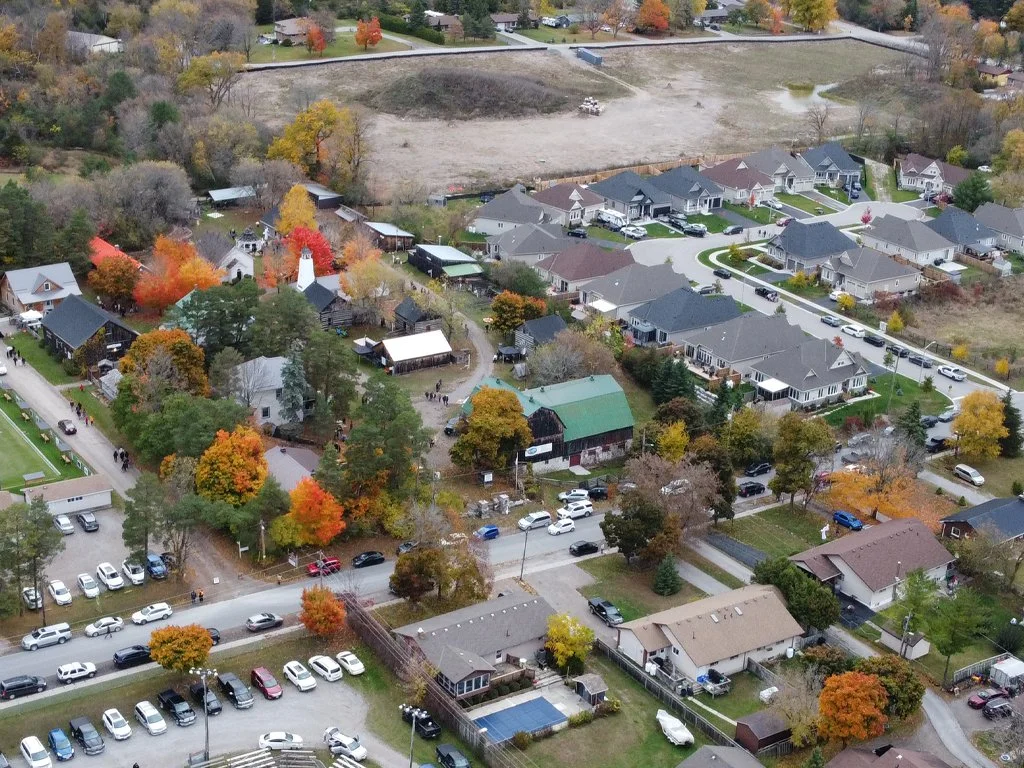
In 1989, the Bobcaygeon Workshop Group opened in Henderson House, which was then located on the north shore of Big Bob Channel, on Front Street, near the Market Square. Artists, carvers, sculptors, potters and other craft workers used Henderson House to meet, spend time together and market their works. Work began on creating a museum in the second storey. This lot had been donated to the village to create a park—which was not taken to include a space for artists. After preparations began to demolish Henderson House, a group of volunteers came together to save Henderson House and transform the Murphy farm into a pioneer village. This group included the reeves of Bobcaygeon (Frank Poole) and Verulam (Neil Oliver). On July 16, 1990, Bobcaygeon Council agreed in principle to devote the Murphy Farm to this new community organization. Countless volunteers did their part to enable Henderson House to move on October 25.
That winter, the site was named Kawartha Settlers Village, and Bert Sevink designed a logo—one of his many contributions to founding the cultural space. Over the years, a pioneer village was assembled by saving many local buildings including the Duggan log cabin (initially located north of Fenelon Falls on 121), the Carriage House from the Mossom Boyd’s Big House, the building from which the Nichols brothers guided fishing parties (Trappers Cabin), the Junkin House, the Orange Hall from Fairbairn Road, a replica of the Bobcaygeon Fire Hall, Fairbairn Church (which for many years had been a chicken coop), the Wray House, the Muir House (formerly the Lindsay Museum) and a shanty from W.T.C. Boyd’s garden. The Murphy’s drive shed was reconstructed, and the outhouse was moved to stand beside the Duggan house. One building at a time, a pioneer village had been constructed, and in 2022 a Visitors’ Centre was built by the gate.
Within a few years, Kawartha Settlers Village became the most popular cultural attraction in the region. True to its founding vision, it was not only a pioneer village, but also housed a great variety of arts, crafts and cultural activities. Thousands of people visit each year to enjoy public events like Settlers’ Day and the Festival of Trees. Today local residents have many fond memories of the times they have spent at Kawartha Settlers Village.